sp_validation
sp_validation validates the weak-lensing catalogues that the
ShapePipe pipeline produces: galaxy
and star shapes, and the many quantities derived from them.
The CosmoStat lab at CEA Paris-Saclay develops it
to prepare and vet the shear catalogues behind the UNIONS cosmic-shear analyses.
The package bundles a Python library with the scripts and notebooks that drive a validation campaign. Together they carry a raw ShapePipe catalogue through to the calibrated, science-ready shear catalogue and the diagnostics a cosmology analysis depends on.
What it does
Four main tasks make up a run, usually in sequence:
Shear validation. Take a shear catalogue carrying metacalibration information, apply the shear calibration, and run diagnostic tests such as PSF leakage. The output is a calibrated shear catalogue. See Running shear validation.
Post-processing. Turn the calibrated catalogue into science-ready catalogues: masking, galaxy-sample selection, and merging of per-campaign catalogues. See Post-processing.
Cosmology validation. Run detailed diagnostics on the calibrated catalogue: rho- and tau-statistics, E-/B-mode decomposition, and comparison plots across catalogue versions.
Cosmology inference. Measure the two-point shear correlation functions and feed a CosmoSIS / CosmoCov pipeline to derive cosmological constraints.
The flow chart below illustrates the path from ShapePipe output products to calibrated, well-selected galaxy catalogues.
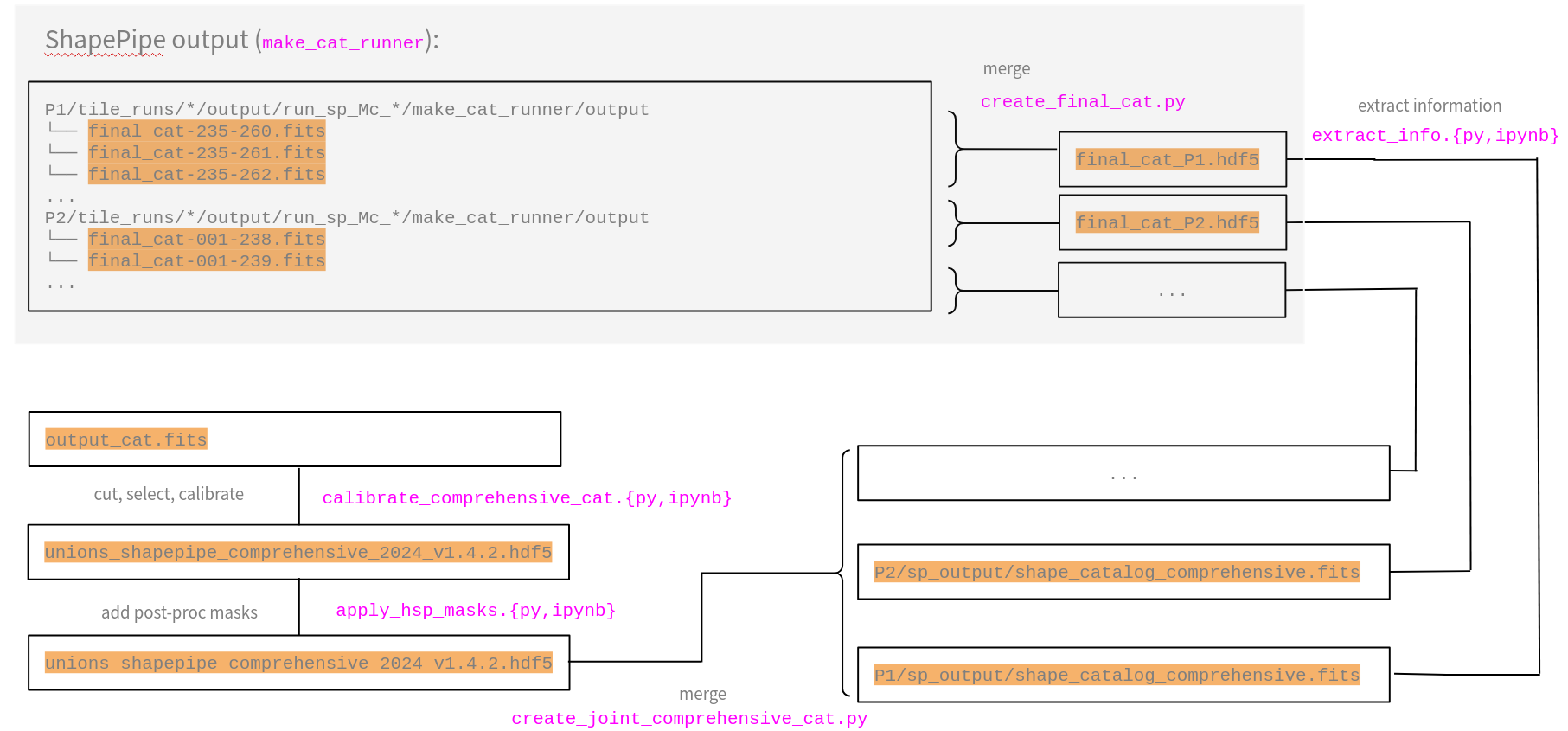
From ShapePipe output products to calibrated and selected galaxy catalogues.
Where to go next
Installation — install via container (recommended) or a development checkout.
Quickstart — an orientation to the four stages of a validation run.
About — the package in its CosmoStat / UNIONS context, with authors and contact.
Repository structure — how the tree is laid out and where each kind of work belongs.
The User Guide in the sidebar walks through each stage: using the released catalogues, running shear validation, post-processing, and the PSF-leakage diagnostics.
The API Reference documents every module of the
sp_validationlibrary.